
Land, Water, and Power: Indigenous Perspectives on Hydroelectricity
Exploring the power of water through Indigenous voices, real-world impacts, and sustainable choices.



Overview
This activity introduces students to hydroelectricity while exploring Indigenous perspectives on land, water, and climate resilience. Through case studies, students analyze benefits, impacts, and solutions, building understanding of energy systems and critical thinking about sustainability and Indigenous rights.
Instructions
What you'll need
- Printed copies of Case Study Worksheet
- Hydroelectricity and Indigenous Peoples slideshow
- Computers for students OR printed copies of resources of each Case Study
Prep
- Print off 5-6 copies of the Case Study Worksheet, enough copies so that each person in each group gets a sheet.
Beginning
- Begin this activity by showing the Hydroelectricity and Indigenous Peoples slideshow
- Slide 2 - share with learners Indigenous land and water values. These values are important as they connect with hydroelectricity.
- Land is an important part of every Indigenous culture within what is called Canada, since the land is what supports life.
- Within many Indigenous cultures, land is seen in relation with all of us, as it helps to nourish and support our livelihood
- For many Indigenous cultures, water represents more than just a resource, being viewed as a living entity deserving of respect and protection.
- As a living entity water can also offers all of us (humans) hydration, food sources, and a way to travel.
- Water nourishes all living things but is also used in Indigenous traditional
and ceremonial practices
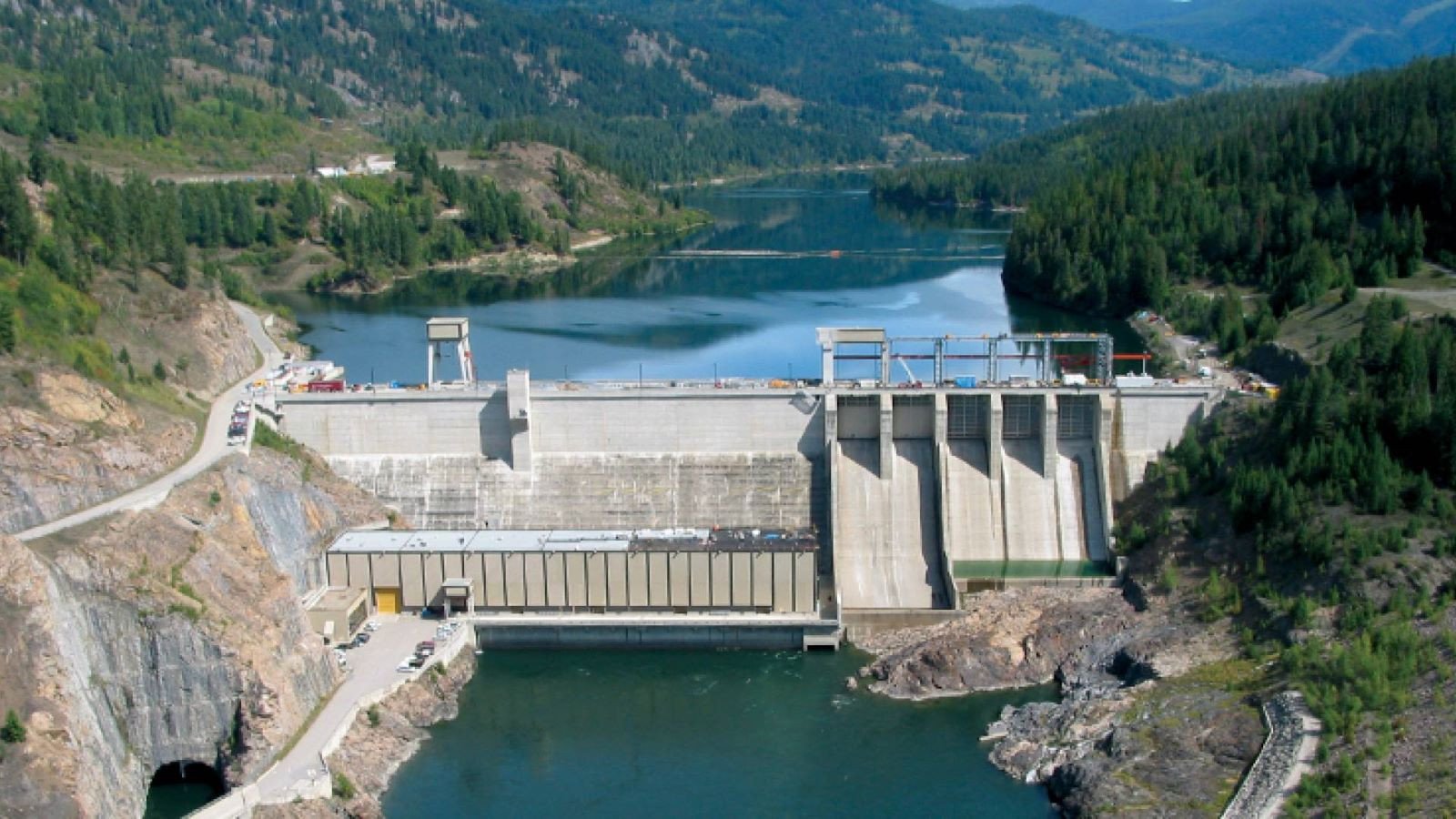
- Slide 3 - teach students about Hydroelectricity. Share that hydroelectricity is electricity generated using the flow of water that drives a turbine which then powers a generator. Explain how it works, highlighting dams, reservior, penstocks, turbines, kinetic/mechanical/electrical energy, generators, transformers, substations, and transmission/power lines.
- Slide 4 - show the visuals of how hydroelectricity is made at BC Hydro.
- Slide 5 – share the definition of climate change with learners. Offer insight into how climate change and climate resilience affects Indigenous peoples. (see Teacher Notes)
Group Work
- Slide 6 - Divide your class into 4 groups and assign the case study number to each group
- Hand out the correct case study to each group member.
- Students will need to read their case study, go over resources provided, and answer the 3 questions on the worksheet.
- Direct students to decide on one person to read the case study, have them organize how resources will be read and shared within the group, and then have them answer the 3 questions together.
- Once students have completed their worksheet, go over each question and gather answers from each Case Study.
Modify or extend this activity
Modifications
- Have the whole class focus on one case study and see the different answers that come up in their research
- Instead of group sharing at the end have a general class discussion
Extensions
Have students create a mini presentation that includes the answers to the questions on the worksheet. They can include additional information about their specific case study form the resources provided
Curriculum Fit
Core Competencies
Communication
- Acquiring and presenting information
- Working collectively
- Supporting group interactions
Thinking
- Questioning and investigating
- Reflecting and assessing
Personal and Social
- Self-regulating
- Building relationships
- Valuing diversity
- Resolving problems
Applied Design, Skills and Technologies 8-9
Big Idea
- Design can be responsive to identified needs (Gr.8)
- Social, ethical, and sustainability considerations impact design (Gr.9)
Content
- Power Technology (Gr.8-Gr.9)
- Uses of power technology (Gr.8)
- Renewable and non-renewable sources of energy (Gr.8)
- Conversion and transmission of energy (Gr.8)
- Kinetic and potential energy (Gr.8)
- Energy transmission and applications (Gr.9)
- Alternative energy sources (Gr.9)
Curriculum Competencies
Applied Design
- Understanding context (Gr.8-Gr.9)
- Empathize with potential users to find issues and uncover needs and potential design opportunities (Gr.8)
- Engage in a period of research and empathetic observation in order to understand design opportunities (Gr.9)
- Ideating (Gr.8-Gr.9)
- Generate potential ideas and add to others' ideas (Gr.8)
- Evaluate personal, social, and environmental impacts and ethical considerations (Gr.8)
- Critically analyze and prioritize competing factors, including social, ethical, and sustainability considerations, to meet community needs for preferred futures (Gr.9)
Applied Skills
- Identify and evaluate the skills and skill levels needed, individually or as a group, in relation to a specific task, and develop them as needed (Gr.8-Gr.9)
Applied Technologies
- Identify how the land, natural resources, and culture influence the development and use of tools and technologies (Gr.8)
- Evaluate how the land, natural resources, and culture influence the development and use of tools and technologies (Gr.9)
Science 8-10
Big Idea
- The behaviours of matter can be explained by the kinetic molecular theory and atomic theory (Gr.8)
- Energy can be transferred as both a particle and a wave (Gr.8)
- Electric current is the flow of electric charge (Gr.9)
- Energy is conserved, and its transformation can affect living things and the environment (Gr.10)
Content
- Kinetic molecular theory (Gr.8)
- Circuits (Gr.9)
- Voltage, current, and resistance (Gr.9)
- Matter cycles within biotic and abiotic components of ecosystems (Gr.9)
- Sustainability of systems (Gr.9)
- First peoples interconnectedness and sustainability (Gr.9)
- Law of conservation of energy (Gr.10)
- Potential and kinetic energy (Gr.10)
- Transformation of energy (Gr.10)
- Local and global impacts of energy transformations from technologies (Gr.10)
Curriculum Competencies
Processing and analyzing data and information
- Apply First Peoples perspectives and knowledge, other ways of knowing, and local knowledge as sources of information (Gr.8-10)
- Seek patterns and connections in data from their own investigations and secondary sources (Gr.8)
- Use scientific understandings to identify relationships and draw conclusions (Gr.8)
- Seek and analyze patterns, trends, and connections in data, including describing relationships between variables and identifying inconsistencies (Gr.9-Gr.10)
- Use knowledge and scientific concepts to draw conclusions that are consistent with evidence (Gr.9-Gr.10)
- Analyze cause-and-effect relationships (Gr.9-Gr.10)
Evaluating
- Demonstrate an awareness of assumptions and bias in their own work and secondary sources (Gr.8)
- Demonstrate an understanding and appreciation of evidence (Gr.8)
- Consider social, ethical, and environmental implications of the findings from their own and others' investigations (Gr.8)
- Describe specific ways to improve their investigation method and the quality of data (Gr.9-Gr.10)
- Demonstrate an awareness of assumptions, question information give, and identify bias in their own work and secondary sources (Gr.9-Gr.10)
- Consider social, ethical, and environmental implications of the findings from their own and others' investigations (Gr.9-Gr.10)
- Critically analyze the validity of information in secondary sources and evaluate the approaches used to solve problems (Gr.9-Gr.10)
Applying and innovating
- Contribute to care for self, others, community, and world through personal or collaborative approaches (Gr.8-Gr.10)
- Transfer and apply learning to new situations (Gr.8-Gr.10)
- Generate and introduce new and refined ideas when problem solving (Gr.8-Gr.10)
Communicating
- Express and reflect on a variety of experiences and perspectives of place (Gr.8)
- Express and reflect on a variety of experiences, perspectives, and worldviews through place (Gr.9-Gr.10)
Environmental Science 11-12
Big Idea
- Complex roles and relationships contribute to diversity of ecosystems (Gr.11)
- Changing ecosystems are maintained by natural processes (Gr.11)
- Human practices affect the sustainability of ecosystems (Gr.11)
- Humans can play a role in stewardship and restoration of ecosystems (Gr.11)
- Sustainable land use is essential to meet the needs of a growing population (Gr.12)
- Living sustainability supports the well-being of self, community, and Earth (Gr.12)
Content
- Energy flow through ecosystems (Gr.11)
- First Peoples knowledge and other traditional ecological knowledge (Gr.11)
- Human actions and their impacts on ecosystem and integrity (Gr.11)
- First peoples ways of knowing and doing (Gr.11)
- Resource stewardship (Gr.11)
- Land management (Gr.12)
- Personal choices and sustainable living (Gr.12)
Curriculum Competencies
Questioning and predicting
- Demonstrate a sustained intellectual curiosity about a scientific topic or problem of personal, local, or global interest (Gr.11-Gr.12)
Processing and analyzing data and information
- Apply First Peoples perspectives and knowledge, other ways of knowing, and local knowledge as sources of information (Gr.11-Gr.12)
- Use knowledge of scientific concepts to draw conclusions that are consistent with evidence (Gr.11-Gr.12)
- Analyze cause-and-effect relationships (Gr.11-Gr.12)
Evaluating
- Demonstrate an awareness of assumptions, question information given, and identify bias in their own work and in primary and secondary sources (Gr.11-Gr.12)
- Exercise a healthy, informed skepticism and use scientific knowledge and findings to form their own investigations to evaluate claims in primary and secondary sources (Gr.11-Gr.12)
- Consider social, ethical, and environmental implications of the findings from their own and others’ investigations (Gr.11-Gr.12)
- Critically analyze the validity of information in primary and secondary sources and evaluate the approaches used to solve problems (Gr.11-Gr.12)
Applying and innovating
- Contribute to care for self, others, community, and world through individual or collaborative approaches (Gr.11-Gr.12)
- Contribute to finding solutions to problems at a local and/or global level through inquiry (Gr.11-Gr.12)
- Implement multiple strategies to solve problems in real-life, applied, and conceptual situations (Gr.11-Gr.12)
Communicating
- Express and reflect on a variety of experiences, perspectives, and worldviews throughplace (Gr.11-Gr.12)
Social Studies 8-10
Big Idea
- Global and regional conflicts have been a powerful force in shaping our contemporary world and identities (Gr.10)
- Worldviews lead to different perspectives and ideas about developments in Canadian society (Gr.10)
Content
- Environmental, political, and economic policies (Gr.10)
- Residential schools and other discriminatory policies and injustices against First Peoples in BC and Canada (Gr.10)
- Domestic conflicts and co-operation (Gr.10)
Curriculum Competencies
- Use Social Studies inquiry processes and skills to ask questions; gather, interpret, and analyze ideas; and communicate findings and decisions (Gr.8-Gr.10)
- Assess the significance of people, places, events, or developments at particular times and places (significance) (Gr.8-Gr.9)
- Assess the significance of people, places, events, or developments, and compare varying perspectives on their significance at particular times and places, and from group to group (significance) (Gr.10)
- Assess the credibility of multiple sources and the adequacy of evidence used to justify conclusions (evidence) (Gr.8)
- Assess the justification for competing accounts after investigating points of contention, reliability of sources, and adequacy of evidence, including data (evidence) (Gr.10)
- Determine which causes most influenced particular decisions, actions, or events, and assess their short-and long-term consequences (cause and consequence) (Gr.8)
- Assess how prevailing conditions and the actions of individuals or groups affect events, decisions, or development (cause and consequence) (Gr.9-Gr.10)
- Explain and infer different perspectives on past or present people, places, issues, or events, and compare the values, worldviews, and beliefs of human cultures and societies in different times and places (perspective) (Gr.8-Gr.10)
- Make ethical judgments about past events, decisions, or actions, and assess the limitations of drawing direct lessons from the past (ethical judgment) (Gr.8)
- Make reasoned ethical judgments about actions in the past and present, and determine appropriate ways to remember and respond (ethical judgment) (Gr.9-Gr.10)
B.C. First Peoples 12
Big Idea
- The identities, worldviews and languages of B.C. First Peoples are renewed, sustained, and transformed through their connection to the land
- The impact of contact and colonialism continues to affect the political, social, and economic lives of B.C. First Peoples
- Through self-governance, leadership, and self-determination, B.C. First Peoples challenge and resist Canada's ongoing colonialism
Content
- Traditional territories of the B.C. First Nations and relationships with the land
- Resistance of B.C. First Peoples to colonialism
- Contemporary challenges facing B.C. First Peoples, including legacies of colonialism
Curriculum Competencies
- Use Social Studies inquiry processes and skills to ask questions; gather, interpret, and analyze ideas; and communicate findings and decisions
- Assess the significance of people, events, places, issues, or developments in the past and present (significance)
- Using appropriate protocols, interpret a variety of sources, including local stories or oral traditions, and Indigenous ways of knowing (holistic, experiential, reflective, and relational experiences, and memory) to contextualize different events in the past and present (evidence)
- Assess the connectedness or the reciprocal relationship between people and place (cause and consequence)
- Explain different perspectives on past and present people, places, issues, or events, and distinguish between worldviews of today and the past (perspective)
- Explain and infer perspectives and sense of place, and compare varying perspectives on land and place (perspective)
- Make reasoned ethical judgments about actions in the past and present, and assess appropriate ways to remember, reconcile, or respond (ethical judgment)
Assessments
- Assess students on participation in group discussion, worksheet answers, and sharing information
- Assess students' ability to read resources and answer questions fully that are connected to resources
- Assess students’ ability to share information and answers based on their research
Teaching Notes
Indigenous Worldviews: Land and Water Relationships
Many Indigenous worldviews understand land and water as living, relational systems rather than resources to be owned or extracted. Humans are seen as part of the natural world, with responsibilities to care for and respect the land, water, plants, and animals. This relationship is often described through concepts such as stewardship, reciprocity, and interconnection. Water, in particular, holds deep cultural, spiritual, and practical significance in many Indigenous cultures—it is understood as a living entity that sustains life, supports ecosystems, and plays an essential role in ceremony and cultural practices. While there are shared values across many Nations, it is important for to emphasize that Indigenous perspectives are diverse and grounded in specific cultural, geographic, and historical contexts.
Climate Change & Indigenous Communities
Climate change affects Indigenous communities in distinct and often disproportionate ways due to their close relationships with land and water systems. Changes in temperature, water levels, and seasonal patterns impact access to traditional foods, disrupt hunting and fishing practices, and threaten culturally significant spaces. For many Indigenous Nations, climate resilience is not only about adapting infrastructure but also about maintaining cultural continuity, land-based knowledge, and food sovereignty. The loss or alteration of land, such as through flooding caused by hydroelectric dams, can reduce communities’ ability to respond to climate change using their own knowledge systems. At the same time, many Indigenous communities are leading climate action through stewardship practices and renewable energy projects that align with their values.
Types of Hydropower Systems
Hydroelectric projects vary in scale and design, and these differences can significantly affect environmental and cultural impacts. Large-scale dam and reservoir systems store water and generate consistent electricity but often flood extensive areas, altering ecosystems and displacing communities. In contrast, run-of-river systems generate power by diverting part of a river’s natural flow without creating large reservoirs, typically resulting in fewer large-scale environmental disruptions. Smaller systems, such as community-based microgrids, can combine hydropower with other renewable sources to provide localized energy solutions. Each type of system involves trade-offs between energy reliability, environmental protection, and community impact, making it important for students to compare how different approaches align with Indigenous values and priorities.
How hydroelectric power is generated
BC Hydro generates power by harnessing the power of moving or falling water to produce mechanical/electrical energy. BC Hydro generates over 43,000 gigawatt hours of electricity annually to supply more than 1.6 million residential, commercial and industrial customers. This power is delivered using an interconnected system of over 73,000 kilometres of transmission and distribution lines.
So how do we generate this power? The process begins before electricity even reaches customers. The steps to generating electricity from a dam and how it is transported are outlined below.
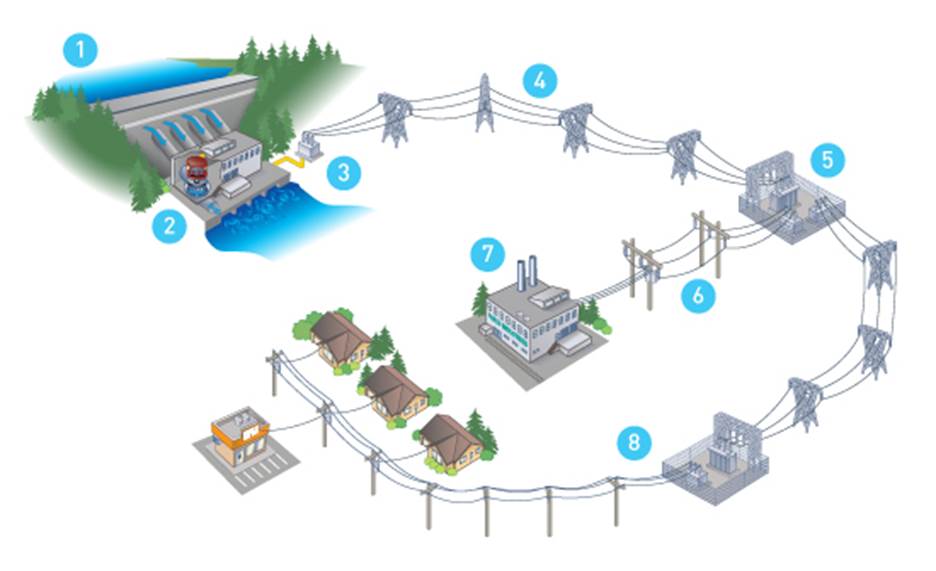
- Hydroelectric dam
There is potential energy stored in a water reservoir behind a dam. It is converted to kinetic energy when the water starts flowing down the penstock, from the dam. This kinetic energy is used to turn a turbine.
- Generator
he falling water strikes a series of blades attached around a shaft which converts kinetic energy to mechanical energy and causes the turbine to rotate. The shaft is attached to a generator, so that when the turbine turns, the generator is driven. The generator converts the turbine's mechanical energy into electric energy.
- Step-up transformer
Voltage is the pressure that makes electricity flow. Generators usually produce electricity with a low voltage. In order for the transmission lines to carry the electricity efficiently over long distances, the low generator voltage is increased to a higher transmission voltage by a step-up transformer.
- Grid high voltage transmission lines
Grid transmission lines, usually supported by tall metal towers, carry high voltage electricity over long distances.
- Terminal Station
Terminal stations control power flow on grid transmission lines and reduce the grid voltage to subtransmission voltage.
- Subtransmission lines
Subtransmission lines supply power from terminal stations to large industrial customers or distribution substations.
- How it is used by the customer
Electric energy can be sold at transmission voltage to users of large amounts who own and operate their own substations. Most customers, however, are unable to accept energy at transmission voltage, and require that it be stepped down in a transformer.
- Distribution substation
A distribution substation is a system of transformers, meters, and control and protective devices. At a substation, transmission voltage is reduced to lower voltages for distribution to residential, commercial, and small and medium industrial customers.
Treaties, Rights, and Consultation
Indigenous rights in Canada are recognized and protected under Section 35 of the Constitution Act, 1982, which affirms Aboriginal and treaty rights. Treaties, such as Treaty 8 in northeastern British Columbia, are agreements between Indigenous Nations and the Crown that outline shared responsibilities related to land and resource use. In modern governance, the Crown has a legal “Duty to Consult and Accommodate” Indigenous Nations when projects may impact their rights or territories. However, consultation does not always mean consent. The United Nations Declaration on the Rights of Indigenous Peoples (UNDRIP) introduces the principle of Free, Prior, and Informed Consent, which emphasizes that Indigenous Peoples should have a meaningful role in decision-making about developments affecting their lands and resources. Understanding these distinctions is key to analyzing hydroelectric projects and their impacts.
Reconciliation in Resource Development
Reconciliation in the context of resource development involves rebuilding relationships between Indigenous Nations, governments, and industry in ways that respect Indigenous rights, knowledge, and self-determination. This includes moving beyond consultation toward meaningful partnerships, co-management agreements, and opportunities for Indigenous ownership and leadership in projects. Examples such as Indigenous-owned or co-developed renewable energy initiatives demonstrate how projects can support both economic development and cultural values. However, reconciliation is an ongoing process, and many challenges remain, particularly where past harms, such as displacement or environmental damage, have not been fully addressed. Educators can support student understanding by highlighting both the progress being made and the work that still needs to be done.
About the Artist
The art design on the worksheet and slideshow in this activity was done my Indigenous artist Kelli Clifton. Kelli Clifton was born and raised in Kxeen (Prince Rupert), British Columbia and is Ts’msyen from the community of Txałgiiw (Hartley Bay). Clifton is both an artist and educator who dedicates her time to learning and teaching Sm’algyax, which is the traditional language of the Ts’msyen peoples. She often incorporates Sm’algyax within her artwork, hoping to inspire others to learn their Indigenous languages.
Career Connections
On this tab, you’ll find information about careers that students may be inspired to explore after completing this activity. These profiles highlight real roles in related fields, helping students see how the skills, knowledge, and interests they are developing can translate into meaningful career pathways. Use this section to spark curiosity, encourage future planning, and show students the many ways they can contribute to a cleaner, more sustainable future.
Below are some potential career paths connected to this activity:
1.Hydrotechnical/Civil Engineer
Hydrotechnical and civil engineers design, analyze, and maintain infrastructure like dams, spillways, and water conveyance systems. At BC Hydro, they ensure structures safely manage water flow, support power generation, and meet environmental and safety standards. They also assess risks such as flooding, erosion, and climate impacts on infrastructure.
2.Protection & Control Engineer
Protection and control engineers design systems that detect faults and protect electrical equipment in power grids. At BC Hydro, they configure relays, monitoring systems, and automation to prevent outages and ensure safe power delivery. Their work helps maintain grid reliability and quickly isolate problems.
3.Construction Officer/Civil Inspector
Construction officers and civil inspectors oversee field construction work to ensure projects meet design, safety, and quality standards. At BC Hydro, they monitor contractors, inspect materials, and verify compliance with engineering specifications. They act as the on-site link between design teams and construction crews.
4.Environmental Coordinator
Environmental coordinators ensure projects comply with environmental laws and minimize ecological impacts. At BC Hydro, they monitor construction activities, develop mitigation plans, and work to protect wildlife, water, and habitats. They also help secure environmental permits and approvals.
5.Natural Resource Specialist
Natural resource specialists manage land, water, forests, and wildlife affected by hydroelectric operations. At BC Hydro, they assess environmental impacts, support sustainable resource use, and provide expertise for planning and operations. Their work balances energy production with conservation priorities.
6.Indigenous Relations Specialist or Coordinator
Indigenous relations specialists build respectful partnerships with Indigenous communities. At BC Hydro, they coordinate consultation, support agreements, and ensure projects consider Indigenous rights, knowledge, and interests. They play a key role in reconciliation and collaborative decision-making.
7.Community Outreach Representative
Community outreach representatives communicate with the public about projects and initiatives. At BC Hydro, they provide information, gather feedback, and address concerns from local communities. Their goal is to build trust and keep stakeholders informed and engaged.
8.Project Manager
Project managers plan, coordinate, and oversee projects from start to finish. At BC Hydro, they manage budgets, timelines, risks, and teams to ensure infrastructure or energy projects are completed successfully. They act as the central decision-maker and point of accountability.
9.Contracts/Procurement Specialist
Contracts and procurement specialists manage purchasing and supplier agreements. At BC Hydro, they source materials and services, negotiate contracts, and ensure compliance with policies and regulations. Their work helps secure cost-effective, reliable resources for projects.
Activity Materials
Select what you need below.

583.4 kb • pdf
182.3 kb • pdf