

Electricity and the Domino Effect
Electricity flows in transmission lines and human cells like a cascading line of dominoes


Overview
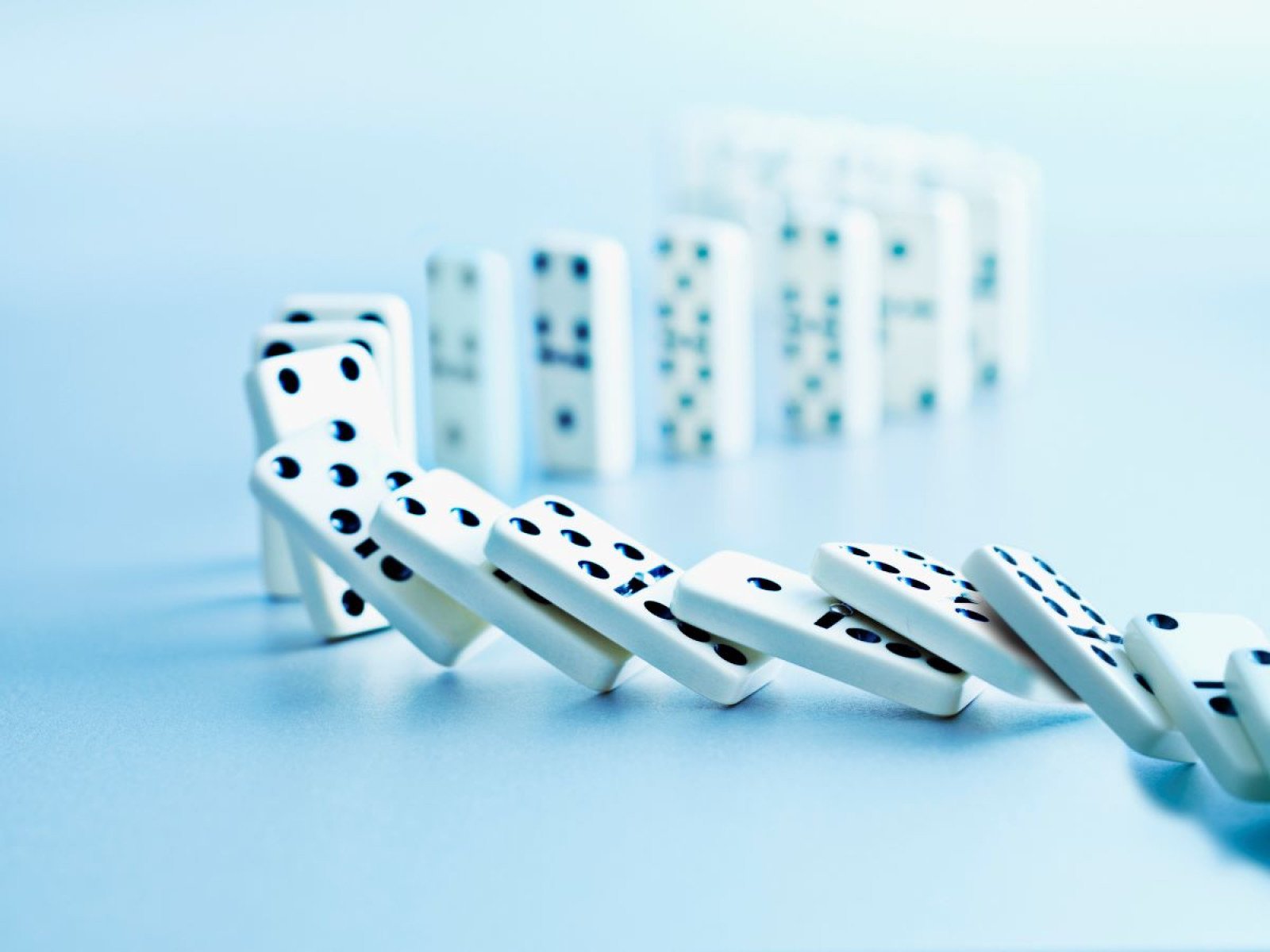
Using dominoes, students explore chain reactions, potential and kinetic energy, and how the signals travel in neurons and transmission lines are similar and different—while also examining what happens when that flow is interrupted. Finally, learners apply their understanding by building obstacle‑filled “transmission lines” with dominoes, simulating real-world electrical systems and challenges.
Instructions
What you'll need
- Laptop, projector and screen
- “Electricity in Human Cells or Transmission Lines?” student handout, print one copy for each student
- Scissors, one pair per student
- “Electricity in Human Cells or Transmission Lines?” handout answer key
- “Domino Effect” student handout, print one copy for each student
- “Electricity and the Domino Effect” slideshow
- 6 sets of dominoes, approximately 28 dominoes per set
- Video: https://www.youtube.com/shorts/b4KP3pD1T6c
Introduction
- Discuss how electricity powers lights and devices.
- Option: use the activity “How does electricity power our lights?”
- Explain that our bodies also use electricity.
- Option: do “Electricity in our bodies.”
Human Cell or Transmission Line?
- Give students the “Electricity in human cells or transmission lines?” handout.
- Have students cut out the statement squares.
- Explain that each statement belongs to Electricity in human cells, Electricity in transmission lines, or Both.
- Students sort the statements into the correct columns.
- Review answers as a class using the answer key.
Domino Effect
- Discuss how in both the human body and transmission lines, there is a chain reaction. Something needs to trigger the transmission.
- Ask students what an example of a trigger event might be in the body? (i.e. touching something hot, reaching out to catch a ball)
- What about the transmission line? (i.e. electricity generation at a dam)
- Review the difference between potential and kinetic energy.
- When the dominoes are lined up and standing, do they have potential or kinetic energy? (potential)
- Put students into 6 groups. Give each group dominoes and each student the Domino Effect handout.
- Get students to complete Experiment 1 together, have them discuss the results, then move to Experiment 2.
- Once students have completed the two experiments, pull up the “Electricity and the domino effect” slideshow.
- Open the “Electricity and the domino effect” slideshow.
- Slide 2 - Ask learners to share how the chain reaction of falling dominoes compares to the nervous system.
- Slide 3 - Explain to learners that triggering a signal means the dominoes won’t fall unless they are pushed. Just like a neuron won’t ‘fire’ until it receives a stimulus. It is also an ‘all or nothing’ response, when the first domino falls it triggers the next one completely. Similarly, a nerve impulse is an all or nothing event. Once the threshold is reached the impulse travels at a constant speed and intensity.
- Slide 4 - Ask learners to share how the chain reaction of falling dominoes compares to the electricity in transmission lines.
- Slide 5 - Explain that there is an activation energy & an energy transfer, both relate to the ways the dominos move to transmission lines.
- Slide 6 - Ask learners to share what happened when they pushed the first domino? The ‘break’ in the line of dominoes causes the ‘domino effect’ to fail. It stops the chain reaction from going further.
- Ask students to share how does this outcome relates to the nervous system?
- Slide 7 - Explain to the learners that in the nervous system a break in the transmission of a nerve impulse could be due to a physical injury like a spinal cord or nerve injury. Damage creates gaps preventing the impulse from propagating past the affected area.
- Slide 8 - Ask learners to share how transmission lines relate to the dominoes break.
- Slide 9 - Explain that a missing domino is like a fallen power line or pole. Ask students what might cause this kind of break in a transmission line? Discuss the different outcomes based on where that line might break.
- For example, if a power pole falls in a neighbourhood, then that neighbourhood might lose power. But if a pole falls somewhere before a substation, which then redirects power to different areas, then whole towns, communities or regions may lose power. This is a cascading or domino effect.
- Slide 10 – Show learners this video: https://www.youtube.com/shorts/b4KP3pD1T6c
- Slide 11 - Share that BC Hydro employs a multi-faceted approach to prevent cascading power outages. These include:
- anti-cascading towers that limit the "domino effect" if one tower fails, preventing the failure from spreading along the line.
- non-combustible poles made of fibre-reinforced polymers to replace damaged or aging wood poles.
- fire-resistant pole wraps are a pilot of steel mesh wraps with a heat-activated coating to shield poles from radiant heat and flames during wildfires.
- planned upgrades and maintenance.
- Slide 12 - Share that transmission lines often travel long distances over many obstacles. Discuss types of natural obstacles they must cross in B.C. such as, mountains, valleys, rivers, lakes and corners.
- Slide 13 - Challenge the groups to build one line with their dominoes and add at least 2 obstacles. One of the obstacles must change the height and it must go around at least one corner. They may also want to build bridges over gaps. Allow them to experiment with what works best and be creative with their ideas.
- Slide 14 - Share that B.C.’s longest single transmission line is the North Coast Transmission Line (NCTL) project, which will be approximately 450km long between Prince George and Terrace.
- Slide 15 - Challenge the class, again, to create one continuous transmission line with all 6 sets of dominoes, including many obstacles and corners and test to see the current move the whole way around without breaking the circuit. Take a video or photo of your class creation and share with BC Hydro
We would love to see your photos and videos of your domino lines, email them to us at schools@bchydro.com
Modify or extend this activity
- Challenge the class to create a more complex domino chain that knocks over other objects (i.e. ping pong balls, levers)
- Add complexity to the domino chains by having them split into multiple lines to go to different destinations, including objects like substations or hydroelectric dams for demonstration
- If there are not enough dominoes to have a full set for each group, divide each set into smaller amounts
- Watch videos of this domino artist creating elaborate domino displays: https://www.youtube.com/@Hevesh5
- Watch this video to explore the difference between potential and kinetic energy in dominoes: https://www.youtube.com/watch?v=ie335CfcXAs
Curriculum Fit
Core Competencies
Communication
- Working collectively
- Determining common purposes
Thinking
- Questioning and investigating
- Designing and developing
Personal and Social
- Building relationships
- Resolving problems
Applied Design, Skills, and Technologies 6
Big Ideas
- Creation of functional domino “transmission lines” reflects design solutions to physical challenges.
- Construction of chain reactions shows the importance of ordered steps and precise arrangement.
- Domino structures serve as a model for understanding real-world electrical systems.
Content
- Foundational designing and building skills
- Prototyping and testing
- Problem-solving through materials and structural adjustments
- Collaborative and iterative design processes
Curricular Competency
Define
- Examine the challenges and constraints related to transmission pathways.
Ideate
- Generate multiple structural possibilities and design solutions.
Prototype
- Construct domino lines with obstacles as working models.
Test
- Activate chain reactions to determine functionality and stability.
Make
- Build complex, multi-step chains to replicate energy transfer through systems.
Science 6
Big Ideas
- Highlights how electricity move though transmission lines, how failures can cascade, and how BC Hydro mitigates environmental and structural challenges.
- The dominoes demonstrate force, motion, and the transfer of potential and kinetic energy.
- Comparing electrical transmission to nerve signaling reinforces understanding of the nervous system and its dependence on uninterrupted pathways.
Content
- Electricity production, circuits, and energy transfer
- Nervous system structure and function
- Forces, motion, and energy
Curricular Competency
Questioning and predicting
- Predictions are made regarding chain reactions, energy transfer, and system failures.
Planning and conducting
- Domino-based investigations are carried out to model electrical and biological transmission.
- Observe, measure, and record data on domino experiments
Processing and analyzing data and information
- Observe and compare how energy transfer occurs in human cells, domino chains, and transmission lines.
- Identify patterns and connections between domino chains, transmission lines, and nervous systems.
Evaluating
- Examine how system failures and interruptions stop energy transfer.
Applying and Innovating
- Design, reconstruct, and refine transmission-line models with obstacles.
Communicating
- Articulate explanations regarding energy flow, cause-and-effect relationships, and system behaviour.
Assessments
- Assess students’ ability to follow instructions and complete tasks.
- Assess students’ understanding of the similarities and differences between electricity transmission in the body and in transmission wires.
- Assess students’ ability to solve problems and experiment with new design ideas.
Teaching Notes
The Domino Effect in Power Grids
The term "domino effect" is a common metaphor used in electrical engineering to describe a cascading outage or blackout. A single failure (like one domino falling) can trigger a sequence of subsequent failures, eventually causing a widespread interruption of power supply to many people. This real-world phenomenon highlights the vulnerability of interconnected systems and the need for robust safety mechanisms.
Major blackouts are usually caused by cascading contingencies, such as a short circuit, an overloaded component, and a generator outage, with complicated interactions. The vulnerability of the system to (in itself) low-probability incidents that expand to a cascading outage (which is also called the domino effect) increases when the system is already stressed by other causes, such as congested transmission corridors when there is a bulk exchange of power between parts of the system. Quite often, a cascading outage is initiated by forces of nature or by weather conditions such as thunderstorms, extreme temperatures, geomagnetic storms and forest fires. The sequence of events leading to a blackout are usually diverse, but the result is always the same: an interruption of the power supply for a certain period of time.
The Domino Effect in the nervous system
The domino analogy effectively illustrates the mechanical nature of signal transmission and energy transfer in the nervous system, making abstract biological and electrical concepts more tangible. You can find more information and activities on this topic from educational resources like the Exploratorium and Khan Academy.
Storm Preparedness
Check out BC Hydro’s information on how to prepare for storm-related power outages in B.C.
https://www.bchydro.com/safety-outages/power-outages/during-an-outage.html
Activity Materials
Select what you need below.

49.3 kb • pdf
1.3 mb • pdf
From the unit:
Grade 6
Electricity in the Body
Go to unit