
Electricity in Our Bodies
Explore how the nervous system in the body works to transmit electrical signals that enable everything from your heart beating to your brain thinking.


Overview
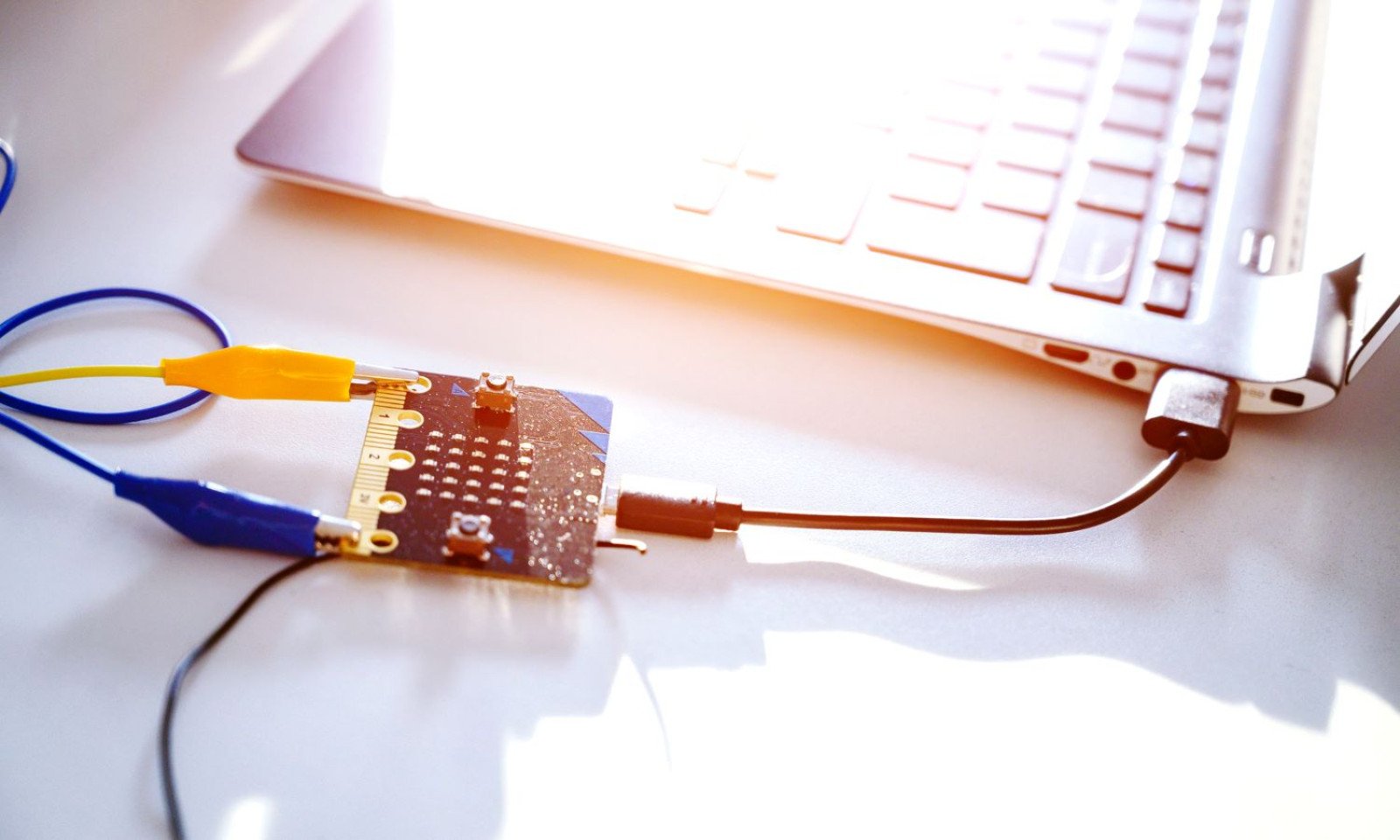
In this activity students explore the idea that their bodies use electricity—much like power lines— to send messages. Students learn that the nervous system acts as the body’s communication network, helping us sense what is happening around us and respond quickly. Using simple electromyography (EMG) equipment, students observe the electrical signals muscles make when they are resting and when they move, building an understanding of how nerves and muscles work together.
Instructions
What you'll need
- Computer and projector or TV
- “Electricity in our bodies” slideshow
- Video: https://www.youtube.com/watch?v=6qS83wD29PY
- “EMG Experiment worksheet”, print one copy per group of 3-4 students
- Group experiment supplies, plan for 3-4 students per group
- Laptop or tablet and internet connection (we suggest using Google Chrome for the browser)
- Micro:bit and connection cable (you can reach out to us for help sourcing micro:bit lending kits in your region)
- 2 alligator clips
- Aluminum foil: fold 2 pieces into squares approximately 4cm x 4 cm
- Tape
Introduction
- Start the activity by having a class discussion on how electricity works to powers our lights and devices and/or do the activity “Tic Tac Flow: How we Generate Hydroelectricity”
- Electricity that powers the lights is the flow of electrons through a metal wire. They flow/are driven by a voltage difference that creates an electric current. This is then transmitted over long distances to be used to power lights and devices. The voltages in power lines are high and measured in kilovolts (kV).
- Ask students if they have ever heard that, like transmission lines, our bodies function by transmitting electrical signals. The voltages however are significantly lower and are measured in millivolts (mV).
Electricity in Human Cells
- Pull up the “Electricity in our bodies” slideshow
- Slide 2 - Share with learners that in their bodies they have cell-based electricity. The flow of positively and negatively charged ions like potassium and calcium across cell membranes creates electrical currents that enable everything from their heart to beat to their brain to think. Their bodies have a nervous system that acts as the body's communication network, sensing the environment and processing information.
- Slide 3 - Share that the nervous system is made up of neurons that allow the body to communicate rapidly and precisely. Ask students what type of message might be communicated in our bodies?
- They may have ideas like if they touch something hot a message might be sent to their brain, and in turn the brain sends the signal back to their muscles to remove their hands.
- Slide 4 - Ask learners to consider electricity in transmission lines. What do electrons do? They cause electricity to flow through the metal transmission wires. Share that electricity in the body is cell-based. The cells use electrical signals to operate and flow through the body.
- Slide 5 – Share with learners that their bodies contain billions of neurons, and their brains also contain about 86 billion neurons all connected.
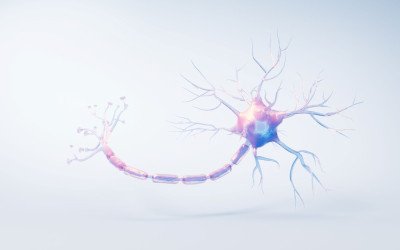
- Slide 6 - Show students the diagram of a typical neuron.
- The tree like dendrites receive signals from other neurons via a chemical messenger (ions) called neurotransmitters.
- The signals cause electrical changes in neurons that are interpreted in the cell body.
- If the signal is strong enough messages are sent down the axon. This signal is called an action potential.
- Slide 7 – Explain to learners that the axon is covered with myelin, an insulator which prevents degrading of the signal.
- With student input, compare this to an electrical insulator in their homes: An insulator is a material that resists the flow of electric current. An example would be the plastic coating around electrical cords.
- The signal then moves to the axon terminal, where the release of neurotransmitters interacts with receptors on the next neuron sending the signal through the body.
- Slide 8 - Share that the cell membrane is the outer layer of the entire neuron and the voltage difference is measured in mV and typically is about -40 to -70 mV. Conversely for electricity transmission lines the voltages are magnitudes higher 60kV to 500kV.
- To check understanding, ask students if this means the inside of the neuron is negative or positive and why that might be. (It’s negative because more negatively charged ions, like Cl, are inside and more positively charged ions, like Na and K are outside)
- Slides 9 & 10 - Show & explain the two types of neurons: sensory and motor.
- Sensory neurons carry incoming information from the sensory receptors of the body towards the brain, for example when they touch something hot.
- Motor neurons carry information from the brain back to the muscles, for example to signal to our muscles to move their hand away from something hot.
- Slide 11 – Show learners video to summarize the learning.
Electromyography (EMG) Experiment
- lide 12 - Ask learners if they know what an electromyography (EMG) test is. This is a test that measures the electrical signals muscles produce at rest and during contraction to check for nerve or muscle activity.
- Explain to the students that they will now do their own version of an EMG. Provide each student with a copy of “EMG experiment worksheet”.
- Put students in groups of 3-4 students and provide each group with the experiment supplies: laptop or tablet, Micro:bit and connection cable, 2 alligator clips, 2 pieces of aluminum foil folded into squares approximately 4cm x 4 cm and tape.
- Have students follow the experiment instructions on the screen working together as a class or in individual groups using the worksheet.
- Once all students have conducted the test have a class discussion on each group’s results.
Modify or extend this activity
- Continue this unit with the next activity: “Electricity and the domino effect”
- Build on your knowledge of electricity in the body and check out the Power Smart for Schools activity “Build a Paper Circuit”. Then using the blank paper circuit template, design a system to light up a path to travel from your hand to your brain showing the flow of electricity.
- Watch this video: Neurons and how do they work
Curriculum Fit
Core Competencies
Communication
- Working collectively
- Supporting group interactions
Thinking
- Questioning and investigating
- Reflecting and assessing
Personal and Social
- Identifying personal strengths and abilities
Science 6
Big idea
- Exploration of internal communication systems in multicellular organisms, emphasizing how neural pathways and electrical signals enable coordinated function and responsiveness.
- Examination of electrical energy transfer, highlighting parallels and contrasts between engineered electrical systems and biological electrical processes
Content
- Human Biology
- Electricity
Curricular Competency
Questioning and predicting:
- Identification of key questions about the nature of electrical signaling on both engineered and biological systems
- Exploration of how ion movement in neurons compares to electron flow in circuits.
- Consideration of how muscle activation might influence electromyographic readings.
Planning and conducting:
- Use of systematic experimental procedures to investigate electrical activity in muscle tissue using Mirco:bit technology
- Implementation of safe and appropriate practices when constructing and testing simple electrical circuits.
Processing and analyzing data and information:
- Interpretation of EMG output to identify patterns in electrical activity during rest and muscle contraction.
- Comparison of electrical signal strength, waveform changes, or measurement stability across trial conditions
Evaluating
- Assessment of the reliability and validity of the collected electrical data
- Reflection on how biological complexity and technological constraints impact measurement accuracy.
Communicating:
- Explanation of experimental observations and data patterns in clear scientific language
- Connection of findings to broader concepts of electricity, neural communication, and human physiology
Assessments
- Assess students’ participation in the group discussion and responses to the critical thinking questions.
- Assess students’ collaboration in the game activity.
- Assess understanding of the components of hydroelectric power generation.
Teaching Notes
Electricity in the body
The nervous system is your body's control hub that send messages throughout your body. This network enables thinking, movement, sensing and automatic actions like breathing. Neurons are specialized cells that quickly transmit signals, helping you react to stimuli and learn new skills.
The nervous system is split into the central nervous system (brain and spinal cord, the main computer) and the peripheral nervous system (nerves to the body, carrying info in and out).
Neurons are tiny nerve cells that pass electrical messages to each other. They use ions (charged particles like sodium and potassium) to create tiny electrical signals (voltage) across their membranes; this "action potential" is how they communicate, like a wave of electrical charge moving down the cell by rapidly opening and closing special channels to let ions rush in and out, sending messages throughout the body. When a neuron is quiet, the inside is negative (around -70mV) compared to the outside, called the resting potential.
When you touch something hot, sensory neurons detect the heat and send a "hot" message up your spinal cord to your brain. The brain instantly responds by sending a "move" message back down through your motor neurons to your arm muscles. As a result, you pull your hand away before you even fully realize that it is hot.
Ions are the "currency," voltage is the "electrical potential," and the neuron is the "wire" that uses voltage changes to send rapid electrical messages (action potentials) to other neurons or muscle.
Electricity in the body versus transmission lines
Human cells use ion flow (sodium, potassium, calcium ions) for internal communication (low voltage, DC-like), creating tiny bioelectric signals for nerve impulses while transmission lines carry massive electron flow (AC/DC currents) at high voltages (kV/m), inducing electromagnetic fields (EMFs). The key difference is the mechanism (ions vs. electrons), scale (millivolts vs. kilovolts), and type of field (internal bioelectric vs. external EMFs), with transmission lines having much stronger fields but cells relying on precise ionic signals for life functions.
Activity Materials
Select what you need below.

1.7 mb • pdf
411.9 kb • pdf
From the unit:
Grade 6
Electricity in the Body
Go to unit