
EV vs Gas Vehicle: Mystery Clue Game
Explore the similarities and differences between Electric and Gas Vehicles and apply that knowledge to real-world examples.



Overview
Students work collaboratively to explore clues related to EVs and Gas cars. By sorting and discussing the clues, they deepen their understanding of how energy sources, environmental impacts, and design features compare across vehicle types.
Instructions
What you'll need
- 10 clues printed and cut out from "EV Gas Mystery Clues Sheet"
- Envelopes
- 4-5 different colour pens or markers
- Whiteboard or big paper
- Sticky puddy or tape
- "EV/Gas People Profile Slideshow"
Before the Game:
- Begin by selecting 5 EV clues and 5 Gas clues from the "Mystery Clue Sheet".
- Print multiple copies of the clues, then cut them out, and place them individually into numbered envelopes (40-50 total).
- Label each set of envelopes in a different ink colour—one colour for each group.
- Hide the clues around the classroom
During the Game:
- Students are divided into 4–5 colour‑coded groups.
- Draw a large T‑chart on the board with “Electric Vehicle (EV)” on one side and “Gas Vehicle” on the other.
- Let the groups search for envelopes in their colour, read each clue, and decide whether it belongs under EV or Gas Car.
- They place each clue on the T‑chart accordingly.
- Once all clues are placed, lead a discussion about each one and why it fits where it does. Point out the similarities and differences to support in the following activity.
After the Game:
- After discussing the clues and students’ reasoning, show the "People Profile Slides". Read each profile aloud and have students write why they think that person would be better suited to an EV or a Gas vehicle. If needed, see Teacher Notes for answers.
- Once students finish, discuss their responses as a class to determine the best vehicle type for each profile. The following slide will provide a brief explanation of the recommended choice.
Modify or extend this activity
- To extend, there can be added clues, instead of 5 can add more making the game longer, by testing more of their knowledge on EVs or Gas vehicles.
- To condense, can offer less clues and go through the people profile as a class, having short discussions about each profile about what vehicle would be best instead of getting them to write their answers individually.
Curriculum Fit
Core Competencies
Communication
- Working collectively
- Focusing on intent and purpose
Thinking
- Questioning and Reflecting
- Reflecting and Accessing
Personal and Social
- Resolving problems
- Contributing to community and caring for the environment
Science 5-8
Big Ideas
- Humans use earth materials as natural resources in different ways. (Gr. 5)
- Devices and technologies can be used to transfer energy from one place to another. (Gr. 6)
- Human practices affect ecosystems, climate, and sustainability (Gr. 7)
- Kinetic and potential energy are produced, transferred, and transformed. (Gr. 8)
Content
- Renewable vs. non-renewable resources (Gr. 5-8)
- Human actions and climate impacts (Gr. 5-8)
- Effects of technologies on society and the environment (Gr. 6)
- Carbon cycle and greenhouse effect (Gr. 7))
- Energy transformation and conservation (Gr. 8)
Curricular Competencies
Questioning and Predicting
- Making predictions about how different vehicle technologies use, convert, and transfer energy.
- Asking questions about electrical systems, battery storage, combustion, and efficiency.
Planning and Conducting
- Making predictions about environmental impact, efficiency, and suitability for the different “People Profiles”.
- Sorting and classifying which vehicle type matches each clue before placing it on the T‑chart.
Processing and Analyzing Data and Information
- Examining clues for evidence about energy conversion (chemical → mechanical, electrical → kinetic), efficiency, and power sources.
- Process real‑world information (implicitly within the clues) to compare the environmental impacts of EVs vs. gas vehicles.
Evaluating
- Considering the benefits and drawbacks of energy systems.
- Evaluating which vehicle type fits each profile and justify decisions with evidence.
Applying and Innovating
- Apply their understanding of energy use, environmental impact, and technology to a real‑world decision‑making scenario.
- Use the clues to build reasoning strategies and apply them to new situations (the People Profiles).
- Explore how emerging technologies (EVs) relate to sustainable solutions.
Communicating
- Clearly explain reasoning during discussion.
- Justifying in writing why each profile fits an EV or gas vehicle.
- Communicate scientific ideas using a T‑chart (visual representation).
Assessments
- Observe students’ ability to work respectfully and cooperatively in a small group.
- Examine if students correctly identify the main differences and similarities between EVs and gas vehicles as they sort clues.
- Listen for students explaining why they think a clue belongs under EV or Gas Vehicle.
- Observe how each group shares materials, takes turns reading clues, and includes all members.
- Evaluate which students are actively searching for clues and contributing to group decision‑making.
- Review students EV/Gas recommendations and observe how they apply earlier clues to real‑world scenarios.
- Examine how students articulate what they found challenging or surprising
Teaching Notes
These teaching notes contain more information on the following topics:
- 4 types of EVs
- Battery range of EV
- Types of chargers
- Main differences between EVs and Gas Vehicles
- Why Gas cars are more convenient/cheaper upfront
- Answers to People Profiles
More Information on EVs
There are 4 different types of EVs. Each type has different qualities but they each have the ability to charge a battery in order to run. The 4 types are:
- Battery EV
- Fully powered by electricity, these vehicles don’t use gas and rely on plug-in charging.
- Plug-in hybrid EV
- Combines a rechargeable battery you can plug-in to charge with a gas engine
- Hybrid EV
- Uses both a gas-powered engine and electric motor but can’t be re-charged from the grid.
- Fuel-cell EV
- Uses hydrogen in the on-board fuel cells to generate electricity that powers an electric motor.
What affects the battery range of an EV
- Battery size
- A larger battery can store more energy, which allows the EV to travel further on a single charge.
- Temperate
- Cold temperatures reduce battery efficiency due to slower chemical reactions to due the cold, and a reduced need for heating that requires more energy.
- Extreme hot temperatures forces cooling systems to work harder.
- Driving Style
- Hard acceleration and sudden stops use more energy.
- Terrain
- Climbing hills requires more power because the motor works harder against gravity.
- Battery health and age
- Over time, batteries slowly lose capacity, meaning they can’t hold as much energy as when they were new.
Different Types of Chargers:
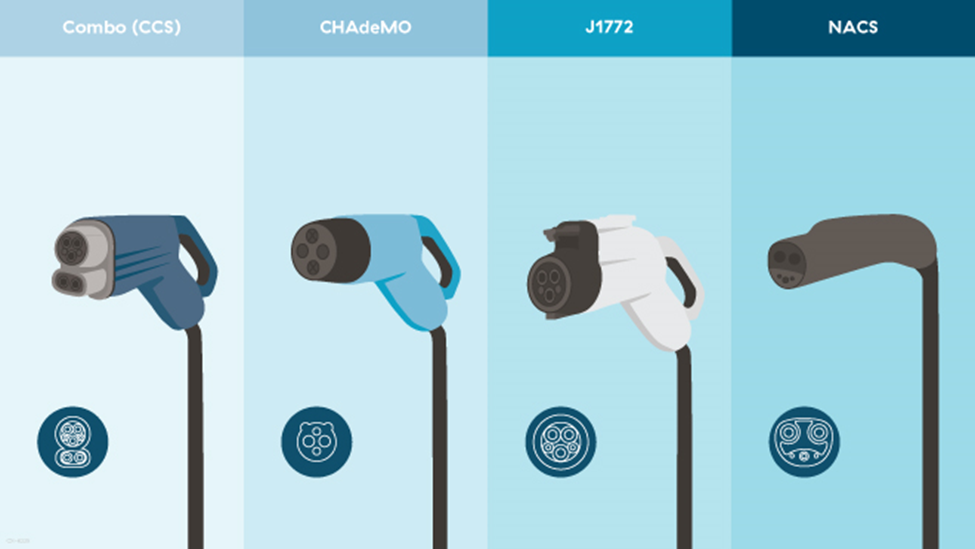
- In one of the EV clues there is a photo of 4 different types of electrical chargers.
- The 4 types are: Combo (CCS), CHAdeMO, a J1772 or a Tesla North American Charging Standard (NACS) compatible port.
- For home EV charging and Level 2 public charging, many EVs use the J1772 connector.
- For fast charging at public charging sites, there are three different connector types used: the Combined Charging System (CCS), CHAdeMO, and the Tesla North American Charging Standard (NACS) connector.
Main Differences between EV and Gas Vehicle
- Battery vs gas tank.
- Electric motor vs combustion engine.
- Charge port vs fuel door.
- No-tailpipe vs tailpipe.
- Regenerative braking vs conventional braking system.
- No fumes for the EV vs fumes coming out of the gas car.
Here are why Gas Cars are more convenient/cheaper upfront than EVs:
- Since there is a bigger used-gas car market, there are more options to buy Gas vehicles at a cheaper cost initially then EVs.
- Over the vehicle’s lifetime EVs can be cheaper, as it costs less to charge them versus fueling up a gas vehicle. They also require less maintenance and repairs throughout its life cycle.
- Since there have been more gas vehicles used throughout the last few decades, it means there are more gas stations accessible then charging ports for EVs.
- As of January 2026, there are over 1500 EV charging sites & gas stations within B.C. Though those numbers are close, it is important to note that about 50% of charging sites are within urban centres across B.C. Gas stations are more dispersed across B.C., especially in rural communities. Access to public EV chargers will continue to get better as BC Hydro and other companies expand their charging networks across B.C.
- Supply chain for gas vehicles are more developed, meaning it increases the availability of gas cars.
- Government tries to offset the higher initial cost of an EV with rebates.
Answers to People Profiles
- Slide 2 - Stacy
- An EV would best suite Stacey
- EVs are eco-friendly just like Stacey.
- EVs are also quieter than gas which would be perfect for where Stacey lives.
- EVs also require less maintenance and repairs making it easy for Stacey as she has limited knowledge on cars.
- An EV would best suite Stacey
- Slide 3 - Sam
- Gas
- Since Sam likes to travel far and in rural places across Canada, a Gas vehicle would be easier to fuel throughout the road trips in different provinces.
- There is also a bigger used gas-car market, so it is easier for Sam to buy a cheaper gas car that is used then an EV.
- Sam also lives in an area with limited access to electric chargers which would make her ability to charge an EV difficult.
- Gas
- Slide 4 - Shawn
- Gas
- Shawn enjoys mechanical work so a Gas car would allow him to do repairs, maintenance, and upgrades.
- Shawn commutes far and lives in a more remote area making access to Gas more accessible than electric chargers.
- Shawn also already has multiple gas-powered equipment and gets affordable gas to his property so a gas vehicle would suite his lifestyle more.
- Gas
- Slide 5 - Tom
- EV
- Tom is trying to reduce his emissions output, so an EV would support in that.
- Tom has a bit more money and wants a vehicle that is new and reliable, sine EVs require less maintenance and overall repairs that would be the best choice for Tom.
- Tom doesn’t drive far so an EV would work well and would allow him to be more eco-friendly.
- EV
Activity Materials
Select what you need below.

377 kb • pdf
160.6 kb • pdf