

Inside an EV: How energy becomes motion
Explore how electricity moves through an electric vehicle and how design choices affect efficiency, charging, and driving performance.



Overview
In this activity, students explore an electric vehicle (EV) as an energy system by tracing how electricity moves from the power grid through the vehicle’s key components to produce motion at the wheels. Using system diagrams and guided analysis, students examine how energy is stored, converted, and controlled inside an EV, and how design choices affect efficiency, charging, range, and real-world use. The activity emphasizes scientific reasoning, systems thinking, and real-world applications connected to senior science, environmental science, and applied technology curricula.
Supporting video
Students may also view How Electric Cars Work, a short video that visually introduces the main components and energy flow inside an electric vehicle. This video can be used as a post-activity hook or as reinforcement during the investigation.
Instructions
What you'll need
- EV and gas vehicle component cards
- Scenario analysis student handout
- How does energy move through a vehicle slide show
- Scenario Analysis Teacher Guide
- Electric cars, how do they work? video
Part 1 – Build the Vehicle Systems
Students will build and compare the energy systems of an electric vehicle (EV) and a gas-powered vehicle.
1. Divide students into groups of 2–3.
2. Distribute EV and gas vehicle component cards.
3. Groups arrange the EV cards in the correct energy-flow order.
4. Groups arrange the gas vehicle cards in the correct energy-flow order.
5. Students draw arrows showing how energy moves through each system.
6. Confirm both systems are complete before continuing.
Part 2 – Compare the Systems
Once both vehicles are built:
1. Identify similarities between the two systems.
2. Identify differences in:
- Energy source
- Number of energy conversion steps
- Braking systems
- Emissions components
3. Be prepared to briefly explain how energy flows differently in each vehicle.
Part 3 – Review the Presentation
You will guide the class through a short presentation explaining energy flow, charging, and vehicle systems.
Follow the slides in order.
1. Slide 2 and 3: Introduce the activity by mentioning that they are going to explore how vehicles actually work as energy systems and instead of focusing on brands or costs, we’ll focus on how energy moves from the source all the way to the wheels. Read the guiding question out loud: how does electricity or fuel become motion at the wheels? Let them know that by the end of this activity, they should be able to explain that process for both types of vehicles.
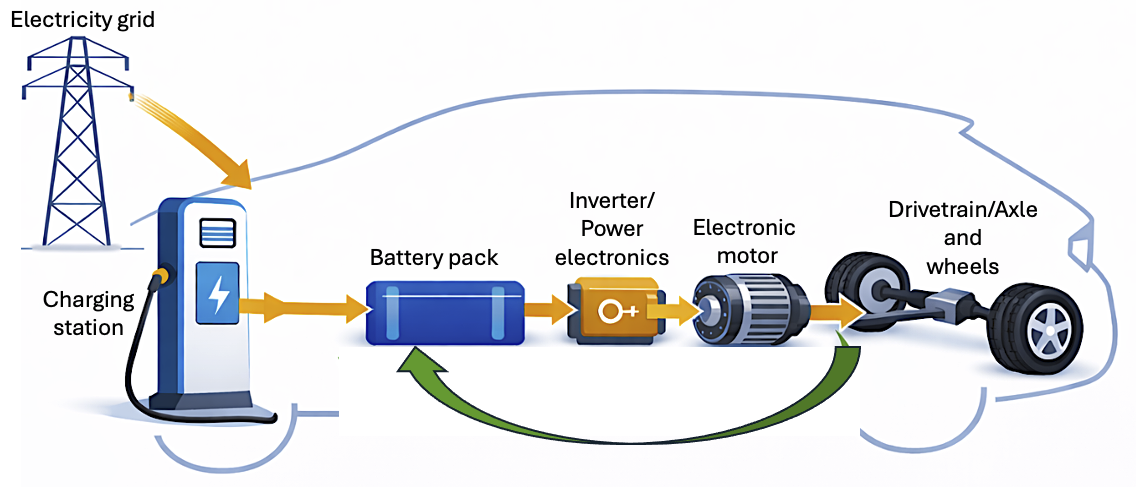
3. Slide 4 and 5: Before moving to the next slides, ensure all groups completed Part 1. Show EV schematic. Explain that in an electric vehicle, energy starts as electricity, is stored in the battery, controlled by power electronics, and then converted into motion by the motor. Notice that this process involves direct electrical-to-mechanical conversion.
5. Slide 6: Show gas vehicle diagram. Explain that in a gas vehicle, the stored energy is chemical. The engine burns fuel, producing heat, which is then converted into mechanical motion. This process involves multiple energy conversions and produces exhaust.
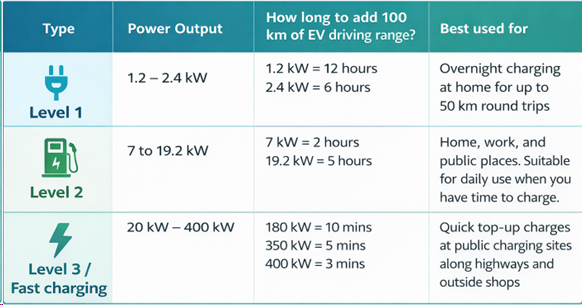
6. Slide 7: Show charging comparison. Mention that electric vehicles can charge at different power levels and different speeds. Higher power chargers deliver energy faster, but charging speed also depends on the vehicle itself and battery conditions.
7. Slide 8: Briefly review factors.
8. Slide 9: Prepare students for scenario analysis.
Part 4 – Real-World Scenario Analysis
1. Provide each group with the scenario handout.
2. Groups discuss all five scenarios.
3. For each scenario, students:
- Identify affected EV components
- Identify affected gas components
- Explain how energy flow changes
- Record their conclusions
The answer to scenario questions can be found in Scenario analysis teacher guide handout.
Part 5 – Group Sharing
1. Each group selects one scenario to summarize.
2. Groups share a short explanation with the class.
3. Encourage students to reference the component cards in their explanations.
Modify or extend this activity
Modifications
- Run the activity as a teacher-guided, whole-class investigation by projecting the visuals and leading discussion instead of group work.
- Provide partially labelled diagrams for students who benefit from additional scaffolding.
- Assign the synthesis questions as a take-home reflection for asynchronous or hybrid learning environments.
Extensions
- Ask students to calculate the approximate charging time using battery capacity (kWh) and charger power (kW).
- Have students compare how temperature or driving style would affect energy flow, efficiency, and range.
- Extend the activity into a short research task on how EV design choices support environmental and energy goals in British Columbia.
Curriculum Fit
Core competencies
Communication
- Exchange ideas and perspectives to build shared understanding during group discussions and investigations.
- Explain scientific and technical concepts using appropriate language, visuals, and diagrams.
- Express reasoning and conclusions clearly through written, visual, or oral explanations.
Thinking
Analyze complex systems by breaking them into parts and examining relationships between components.
Apply critical and creative thinking to interpret information, make connections, and draw evidence-based conclusions.
Reflect on learning by revising explanations based on new information and peer discussion.
Personal and Social
Collaborate respectfully with others to explore complex problems.
Demonstrate responsibility and awareness of how technological choices affect society and the environment.
Consider multiple perspectives when discussing energy use and environmental impacts.
Grade 10–11 Science
Big ideas
- Energy is conserved and its transformation can affect living things and the environment (Science 10).
- Local and global impacts of energy transformations from technologies (Science 10).
- Actions and decisions affect the local and global environment (Science for Citizens 11).
Content
- Energy transfer and transformation (Science 10).
- Environmental impacts of technologies (Science 10).
- Human use of energy and resources (Science for Citizens 11).
Curricular competencies
Questioning and predicting
- Demonstrate a sustained intellectual curiosity about a scientific topic or problem of personal interest.
- Ask questions to clarify relationships among energy, technology, and environmental impact.
Processing and analyzing data and information
- Analyze information from models, diagrams, and visuals to make sense of energy systems.
- Identify patterns and connections within complex technological systems.
Evaluating
Evaluate the impacts of technological choices on efficiency, energy use, and the environment.
Grade 12 Science
Big ideas
- Energy systems can be analyzed to understand efficiency, sustainability, and technological innovation (Physics 12 / Environmental Science 12).
- Human choices related to energy production and consumption influence environmental sustainability (Environmental Science 12).
- Complex systems require analysis of inputs, outputs, feedback loops, and constraints (Physics 12).
Content
- Energy transformations, efficiency, and power in technological systems (Physics 12).
- Sustainable energy technologies and environmental impact (Environmental Science 12).
- Quantitative analysis of energy use, power, and system performance (Physics 12).
Curricular competencies
Analyzing and interpreting data
- Apply quantitative reasoning to evaluate energy efficiency and power use in electric and gas vehicle systems.
- Interpret models and diagrams to explain system behavior under different conditions.
Evaluating technological solutions
- Assess trade-offs in energy systems, including infrastructure, efficiency, and environmental impact.
- Evaluate evidence to support conclusions about sustainable transportation technologies.
Applying and innovating
- Apply knowledge of energy systems to propose improvements or alternative solutions.
- Connect scientific principles to real-world technologies and emerging innovations.
Grade 10–11 Social Studies
Big ideas
- Environmental, political, and economic decisions impact people and the environment (Social Studies 10).
- Natural resource use and technological development affect sustainability (Social Studies 11).
Content
- Environmental and economic factors influencing technological development (Gr. 10–11).
- Sustainability and resource use (Gr. 11).
Curricular competencies
Analyzing and interpreting evidence
- Analyze how technological systems influence environmental outcomes.
- Use evidence to explain cause-and-effect relationships between energy use and environmental impact.
Assessments
- Observation of group discussions and reasoning
- Evaluation of student explanations or annotated diagrams
- Formative assessment through guiding questions
Teaching Notes
These teaching notes contain more information on the following topics:
- Understanding electric vehicles as energy systems
- Key EV components and their roles
2.1. Temperature effects on EV components - Energy flow, conversion, and efficiency
3.1. Regenerative braking and energy flow - Charging speed, power, and real-world constraints
- Comparing electric and gas-powered vehicles
- Common student misconceptions
1. Understanding electric vehicles as energy systems
This activity is designed to shift students’ thinking from viewing vehicles as mechanical objects to understanding them as energy systems. Emphasize that an electric vehicle (EV) is fundamentally about how energy is stored, converted, controlled, and used.
Teachers do not need to cover advanced electrical engineering concepts. Instead, focus on:
- How electricity moves through a system
- How different components have specific roles
- How design choices affect performance and efficiency
Encourage students to describe processes in their own words rather than memorizing component names.
2. Key EV components and their roles
Students may be familiar with batteries and motors but less familiar with power electronics. When discussing components, consider using simple functional language:
- Battery (kWh): Stores electrical energy for later use. Battery capacity affects how far the vehicle can travel.
- Inverter / power electronics: Controls the flow of electricity and converts it into the form needed by the motor.
- Electric motor: Uses electromagnetic forces to convert electrical energy directly into motion.
- Drivetrain and wheels: Transfer motion to the road.
- Regenerative braking: Allows the motor to act as a generator, recovering some energy during slowing or braking.
If students ask about voltage or detailed circuitry, acknowledge the question but keep discussion at a conceptual level unless it aligns with course goals.
2.1. Temperature effects on EV components
Cold and hot temperatures affect electric vehicle performance because batteries and electronic systems operate most efficiently within specific temperature ranges.
In cold conditions:
- Battery chemical reactions slow down, reducing available capacity and power output.
- Range may temporarily decrease.
- Charging speed may be reduced to protect the battery.
- Cabin heating draws additional energy from the battery.
- Regenerative braking may be limited when the battery is very cold and cannot efficiently accept incoming energy.
In hot conditions:
- The battery management system may use energy for cooling.
- Charging speeds may be reduced to prevent overheating.
- Sustained high temperatures can accelerate battery degradation over time.
Teachers may emphasize that these effects are related to battery chemistry and thermal management systems, not mechanical failure.
3. Energy flow, conversion, and efficiency
A key learning goal is helping students understand that energy is not lost, but transformed.
You may want to reinforce:
- Energy transformations (electrical → mechanical)
- Efficiency losses (heat, friction, resistance)
- Why EVs tend to be more efficient than gas vehicles due to fewer energy conversion steps
If helpful, contrast this with gas vehicles:
chemical energy → thermal energy → mechanical energy
This comparison helps students understand why EVs use energy differently.
3.1. Regenerative braking and energy flow
Regenerative braking changes the direction of energy flow within the vehicle system. When the driver slows down, the electric motor temporarily acts as a generator. Instead of releasing kinetic energy as heat (as in conventional braking systems), some of that motion energy is converted back into electrical energy and stored in the battery.
This introduces the concept of feedback loops in energy systems. Energy flows from the battery to the motor during acceleration, and from the motor back to the battery during deceleration.
Teachers may highlight that regenerative braking:
- Improves overall system efficiency.
- Is most effective in stop-and-go driving.
- May be reduced in very cold conditions if the battery cannot accept energy efficiently.
This concept helps students understand that EV energy flow is not strictly linear but dynamic.
4. Charging speed, power, and real-world constraints
Students often assume that faster chargers always mean faster charging. Clarify that charging speed depends on both the charger and the vehicle.
Key points to emphasize:
- Power (kW) describes how fast energy is delivered.
- Energy (kWh) describes how much energy is stored and used.
- Vehicles battery management system controls how much power they can accept.
- Charging slows as the battery fills to protect battery health.
Use everyday analogies if helpful (e.g., filling a bottle quickly at first, then slowing near the top).
5. Comparing electric and gas-powered vehicles
When comparing EVs and gas vehicles, guide students toward systems-level thinking, not brand or cost debates.
Focus discussion on:
- number of moving parts
- energy conversion pathways
- braking systems
- on-road emissions
Avoid framing the discussion as “EVs are better” — instead, emphasize how and why they function differently, allowing students to reach evidence-based conclusions.
6. Common student misconceptions
Teachers may encounter the following misconceptions:
- “EVs don’t create emissions at all.”
Clarify the difference between on-road emissions and lifecycle emissions. - “Fast chargers damage all batteries.”
Explain that vehicles are designed to manage charging safely. - “EVs need to be charged every day.”
Encourage students to think in terms of driving distance and energy use, not habits.
Use these moments as opportunities for clarification rather than correction.
Career Connections
On this tab, you’ll find information about careers that students may be inspired to explore after completing this activity. These profiles highlight real roles in related fields, helping students see how the skills, knowledge, and interests they are developing can translate into meaningful career pathways. Use this section to spark curiosity, encourage future planning, and show students the many ways they can contribute to a cleaner, more sustainable future.
Below are some potential career paths connected to this activity:
1. Electrical Engineer
Electrical engineers design and develop systems that generate, store, and use electricity. In the transportation sector, they may work on electric vehicle batteries, charging infrastructure, power electronics, or grid integration systems.
Possible education path: Electrical Engineering
2. Automotive Service Technician (EV Specialist)
Automotive technicians diagnose, repair, and maintain vehicles. With the growth of electric vehicles, many technicians now specialize in high-voltage battery systems, electric motors, and onboard electronics.
Possible education path: Automotive Service Technician Program
3. Energy Systems Analyst
Energy analysts study how energy is produced, distributed, and used. They help organizations understand electricity demand, charging infrastructure needs, and the environmental impacts of energy systems such as electric transportation.
Possible education path: Sustainable Energy Engineering
4. Power Systems Engineer
Power systems engineers design and manage the electrical grid, ensuring that electricity can be delivered safely and reliably. As more electric vehicles are adopted, these engineers help plan charging networks and manage increased electricity demand.
Possible education path: Electrical Engineering
5. Transportation Planner
Transportation planners design systems that help people move efficiently and sustainably. They may work on integrating electric vehicles, public transit electrification, charging station placement, and future transportation infrastructure.
Possible education path: Urban Planning
6. Environmental Scientist
Environmental scientists study how technologies and human activities affect the environment. They assess the environmental impact of transportation systems, energy use, and emissions, helping guide sustainable policy decisions.
Possible education path: Environmental Science
Activity Materials
Select what you need below.

327.5 kb • pdf
717.2 kb • pdf
184.1 kb • pdf
166.6 kb • pdf